
.svg)
First Tech Conference Tips: Leave the Ego at the Door
Your first tech conference as a career changer or veteran can be intimidating. Here's how to show up prepared and build real connections instead of chasing names.
June 11, 2026

The first time you walk into a real tech conference, it can feel like stepping onto another planet.
Lights everywhere. Booths stacked wall to wall. Conversations moving faster than your confidence. Acronyms flying around like mosquitoes in July. People wearing badges with titles you do not understand yet, talking about products, platforms, certifications, architecture, AI, security, automation, cloud, networking, and whatever else the industry decided to rename this quarter.
And there you are.
Transitioning.
Trying to look calm while your brain is whispering, “You do not belong here.”
I know that feeling.
But here's what I've also seen: students, career changers, veterans, military spouses, and people rebuilding their professional identity from the ground up walk that same floor and realize something powerful.
They do belong here.
They just need to learn how to enter the room.

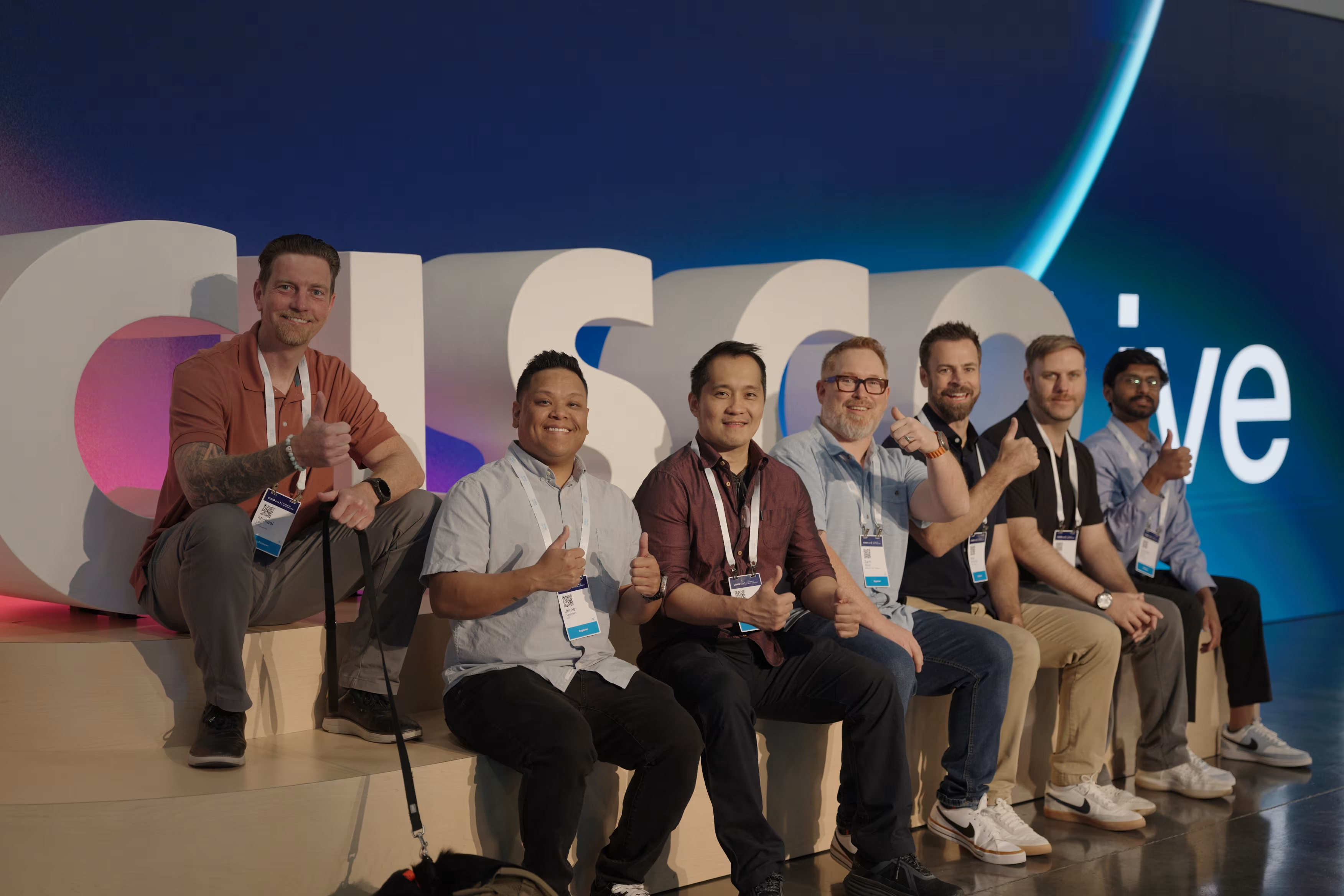
At Cisco Live, I got to watch that happen in real time. Walking the floor with our NGT students, alongside Nick and TK, felt like watching something bigger than a conference. It felt like watching people step into a world they had only seen from the outside. There was pride in that. Real pride. The kind that hits you in the chest before your brain gets a chance to explain it.
They were walking it like they belonged. Infiltrating it, in the best possible way.
And here is the part people miss. You do not win at a tech conference by pretending to be the smartest person in the room. You win by being human enough, humble enough, and hungry enough to learn from the room.
There are three things every transitioning professional needs when they walk into a tech conference, career fair, or networking event.
1. Humility
Humility is not weakness.
Humility is walking into the room with your head up and your ego quiet.
You do not need to know everything. You are not supposed to know everything. That is the whole point. If you already had it all figured out, you would not need the conference, the program, the mentor, the lab, the certification, or the conversation.
The problem is that a lot of transitioning professionals feel pressure to prove themselves immediately. Veterans especially can fall into this trap. We come from environments where credibility mattered. Rank mattered. Experience mattered. Competence mattered. Then we step into tech and suddenly the language changes, the rules change, and the room does not automatically understand what we have done or who we have been.
That can sting a little.
Good.
Let it sting, then let it teach you.
Humility gives you permission to ask better questions. It gives you permission to listen. It gives you permission to say, “I am learning this field, and I am serious about where I am going.”
That lands better than fake confidence every single time.
2. Leave Your Ego at the Door
Your past matters.
Your title mattered. Your uniform mattered. Your leadership mattered. Your experience mattered.
But if your entire identity is built on who you used to be, you are going to struggle with who you are becoming.
That is the hard truth.
A tech conference is not the place to walk around expecting people to decode your resume, translate your military experience, and hand you an opportunity because you survived hard things. That is not how this works.
Respect is built differently here.
You build it through curiosity. Through follow-up. Through preparation. Through the ability to tell your story without turning it into a hostage situation.
Nobody wants the seven-minute monologue about your entire career history while they are trying to drink bad conference coffee and make it to the next session.
Give people something real.
Try this instead:
“I am currently transitioning into network engineering. I have been building my foundation through NGT, focusing on core networking, subnetting, Layer 1, troubleshooting, and the full stack skill set. I am here to learn, meet people doing the work, and better understand where I can bring value.”
That is clean.
That is confident.
That does not smell like desperation.
Because here is the mistake too many people make. They walk up to someone and ask for a job before they have earned a conversation.
Slow down, cowboy.
You are not there to collect names like Pokémon cards. You are there to build a network. A real one. Meaningful relationships. Human first. Character over skill set.
Skills can be built. Labs can be repeated. Certifications can be earned. Tools can be taught.
Character walks in with you.
3. You Only Know What You Know
This one will save you a lot of embarrassment.
You only know what you know.
That means you do not bluff. You do not inflate. You do not pretend you have mastered something because you watched three videos and survived one packet tracer lab at midnight with a cold cup of coffee and a prayer.
Be honest about where you are.
There is power in saying, “I am still learning that.”
There is even more power in saying, “Here is what I am doing to get better.”
That is the bridge.
That is where NGT matters so much. The Full Stack Network Associate, the Full Stack Network Architect, the Network Cyber Security Associate, and the growing set of tools around the student experience give people a real path. Not theory floating in the clouds. A path. A structure. A way to build the muscle.
And now, as AI becomes part of the full stack conversation, the timing matters even more. The industry is moving. Fast. The people who succeed will not be the ones who pretend they know everything. They will be the ones who can learn, adapt, communicate, and stay grounded while the ground keeps shifting.
That is the game now.

The Human Connection Still Wins
The best conversation I had at Cisco Live did not start with a pitch.
It started at breakfast.
A gentleman was sitting with us, and I simply asked him, “How are you enjoying Live?”
That was it.
Just a human question. No pitch deck, no hard sell, no badge scan.
And that question opened the door.
Turns out, he was the Director of Network Engineering for Dollar General. More importantly, he was someone who believed deeply in the foundation of network engineering. Manual subnetting. Layer 1. Real troubleshooting. The core skills. The stuff NGT teaches from the gate.
He was listening to a recording when the conversation started. Then he stopped it.
That matters.
He stopped what he was doing because the conversation became worth paying attention to.
That is what human connection does when it is real. It cuts through the noise.
By the end of that breakfast, I had not just met another name at a conference. I had made a connection. Someone I could reach out to. Someone I could learn from. Someone who understood the value of building people the right way.
That does not happen when you treat people like stepping stones.
It happens when you treat them like people.
Wild concept, I know.
Your Story Matters, But Learn How to Tell It
Storytelling is not optional anymore.
If you are transitioning into tech, you need to be able to explain who you are, where you have been, what you are building, and where you are going.
But storytelling does not mean dumping your entire life onto someone in the first two minutes.
A good story creates curiosity.
A bad story creates an escape plan.
Tell people what you are doing now. Tell them what you are working toward. Tell them why it matters to you. Then stop talking long enough to let the other person into the conversation.
Sometimes the most powerful thing you can ask is, “How did you get into this field?”
Or, “What do you wish more people understood about this work?”
Or, “What would you tell someone trying to break into this space the right way?”
Those questions do something important. They show respect.
And respect opens more doors than a desperate ask ever will.
The Momentum Should Make You Feel Alive
What happened at Cisco Live should make every NGT student feel momentum.
Not hype. Hype fades by the time the hotel coffee wears off.
Momentum is the sense that we are building something real, and that there is a place here for people willing to learn, work, listen, and grow.
Watching students walk that floor, have conversations, make connections, and start seeing themselves in the room was special. Because when someone who once felt intimidated starts walking with purpose, something changes. Their shoulders shift. Their voice steadies. They stop looking around like they are trespassing.
They start acting like they are in the right place.
Because they are.
Final Thought
Your first tech conference is not about proving you belong.
It is about learning how to show up.
Show up humble.
Show up prepared.
Show up human.
Leave the ego at the door. Tell the truth about what you know and what you are building. Ask better questions. Listen harder. Do not chase names. Build relationships.
And when you feel overwhelmed, remember this.
Everybody in that room started somewhere.
Some just forgot what it felt like.
Do not be one of those people.
Walk in hungry. Stay humble. Make the connection.
Then get back to work.
Your Move
Ready to build the foundation that lets you walk into any room like that? See if you qualify.