
.svg)
Will AI Replace Your Job? What John Henry Teaches Us
AI is changing every career. The 150-year-old story of John Henry reveals the one skill that outlasts every machine, and how to start building it now.
June 26, 2026
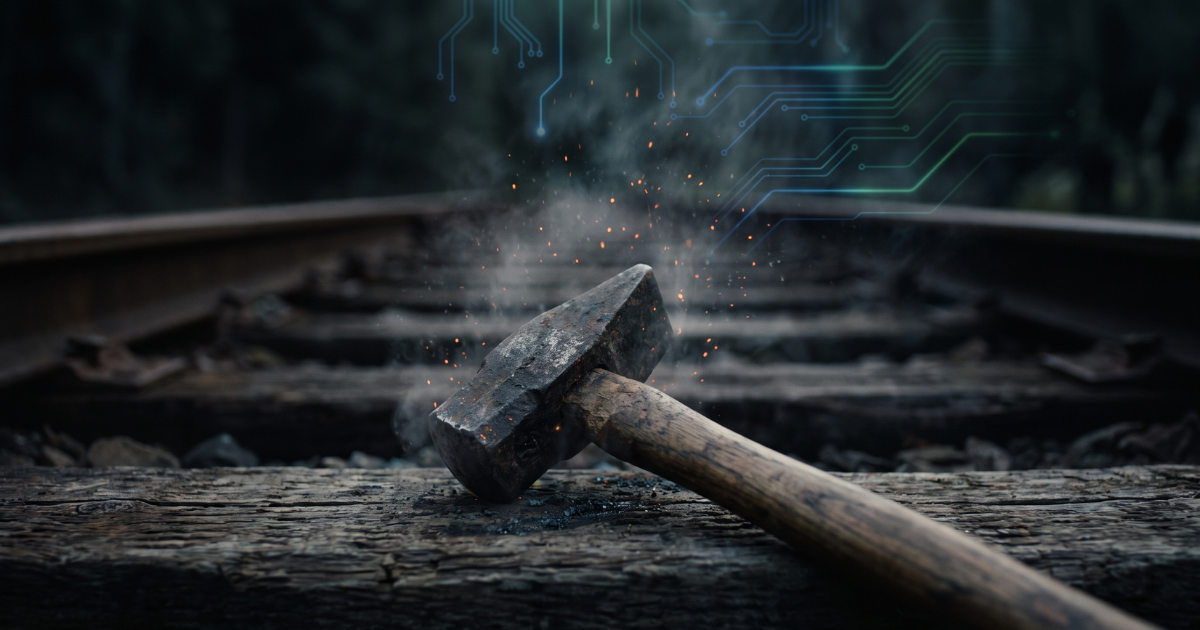
AI is forcing millions of people to ask a question workers have faced for generations: will a machine replace what you have spent years learning to do?
John Henry faced that question long before artificial intelligence existed. He challenged a steam-powered drill to prove human effort could still beat a machine. He won. Then he died. The machine stayed.
That is the part of the story that keeps pulling me back. As kids, many of us were taught that John Henry won. As adults, I am not so sure. If you outrun the future and collapse at the finish line while the future keeps moving, what exactly did you win?
Maybe he never raced the steam drill at all.
Maybe he raced the realization that the world was changing without asking his permission.
That is a race every generation eventually runs.

Every Generation Gets Its Own Steam Drill
The railroad workers of John Henry's time were not afraid of the machine itself. They were wrestling with something deeper.
Would their skills still matter? Would there be a place for them in what came next?
Those questions have not changed. We just ask them about AI now, and not only in the trades. Engineers, teachers, marketers, project managers, veterans leaving the service, and military spouses rebuilding careers after another move all ask the same thing. The technology keeps changing. The human question stays remarkably consistent.
For the first time in modern history, knowledge workers are feeling what industrial workers felt generations ago. The machine is no longer challenging our backs and hands. It is challenging our cognitive work. It writes, summarizes, analyzes, and creates. And that creates an uncomfortable tension, because most people are not actually worried about technology. They are worried about significance. They are trying to figure out where they fit in a world changing faster than they can plant their feet.
History is oddly reassuring here.
Every major shift created the same uncertainty. When the automobile arrived, the horse-and-carriage trades faded and mechanics became essential. When computers entered the office, information mattered more than paperwork. When the internet connected everything, having access to knowledge mattered less than knowing how to evaluate and apply it.
Every generation gets its own disruption, is convinced theirs is the one that breaks the pattern, and then discovers that adaptation is still the most valuable thing a person can carry.

The Skills That Outlast the Tools
The people who come through these transitions intact are rarely defined by the tools they happened to use. They are defined by what they stand on: curiosity, discipline, resilience, and the willingness to start over and keep going when progress feels slow.
Those traits outlasted steam engines, electricity, computers, and the internet.
They will outlast AI too.
We talk about this a lot at NGT. Technical skills matter, but they are rarely the whole story. Networking changes. Security changes. Cloud changes. The stack evolves, platforms rise and fall, certifications expire, and whole industries reinvent themselves. The people who keep growing are usually standing on a foundation much older than whatever they are currently learning. A farmer becoming a factory worker. A blacksmith becoming a mechanic. A chef learning cybersecurity. A veteran stepping into tech for the first time.
Different stories, same foundation: the ability to learn, the courage to adapt, and the humility to begin again.
That is why I think the lesson of John Henry is usually misread. The hammer was never the story. Neither was the steam drill. The story was the human standing in front of change, trying to find meaning in a world rearranging itself around him.

What To Do When Your Steam Drill Arrives
We are all standing in front of our own version of that drill. For some it is AI. For others it is a layoff, a promotion, a career change, retirement from the service, or a chapter they did not see coming. The question was never whether change is coming. It is already here. The question is what you have built beneath your feet for when it arrives.
John Henry swung a hammer. We carry laptops. Different tools, same question: who am I when the thing I mastered is no longer enough?
I do not think that question has a comfortable answer, and I would be suspicious of anyone who handed me one. But the people who sit with it long enough tend to find the same thing John Henry's story has been pointing at the whole time. It was never really about the machine. It was about the person willing to learn, adapt, and keep moving when the ground shifts.
Every generation gets its own steam drill. Ours happens to be AI. So it is worth being honest with yourself about where you are digging in because change feels uncomfortable, uncertain, or unfair, and then taking one real step this week into whatever you have been putting off.
The world is changing whether we are ready or not. What we do next is the only part that is ours.
Frequently Asked Questions
Will AI replace my job?
AI is more likely to change your job than erase it. It automates specific tasks like writing, summarizing, and analysis, which shifts what your role rewards. The people most at risk are those who refuse to adapt. The people who stay valuable keep building transferable skills like problem solving, communication, and continuous learning.
What skills will stay relevant in the age of AI?
The skills that outlast technology are rarely technical ones. Curiosity, discipline, resilience, communication, and the willingness to learn have survived every major shift from industrialization to the internet. Technical skills still matter, but they expire. A strong foundation of adaptability is what lets you keep learning the next tool, and the one after that.
Is it too late to change careers because of AI?
No. Every major technological shift has moved people from fading roles into new ones, from farmers becoming factory workers to veterans entering tech today. What matters is not your starting point but your willingness to learn and adapt. Career changers, veterans, and military spouses retrain successfully at every age by building durable skills rather than chasing a single tool.
What is the real lesson of the John Henry story?
John Henry beat the steam drill but died from the effort, while the machine stayed. The deeper lesson is not about competing with technology. It is about identity and adaptation: who you are when the skill you mastered is no longer enough. The people who thrive through change are defined by their ability to learn, not by the tools they once used.
Ready to build a foundation that outlasts the tools?
At NGT, we help career changers, veterans, and military spouses build the durable skills that survive every shift in technology. If you are ready to take one real step, talk with our team about which path fits where you are headed.